The Anatomy of a Hybrid Piano: How Its Key Action Works

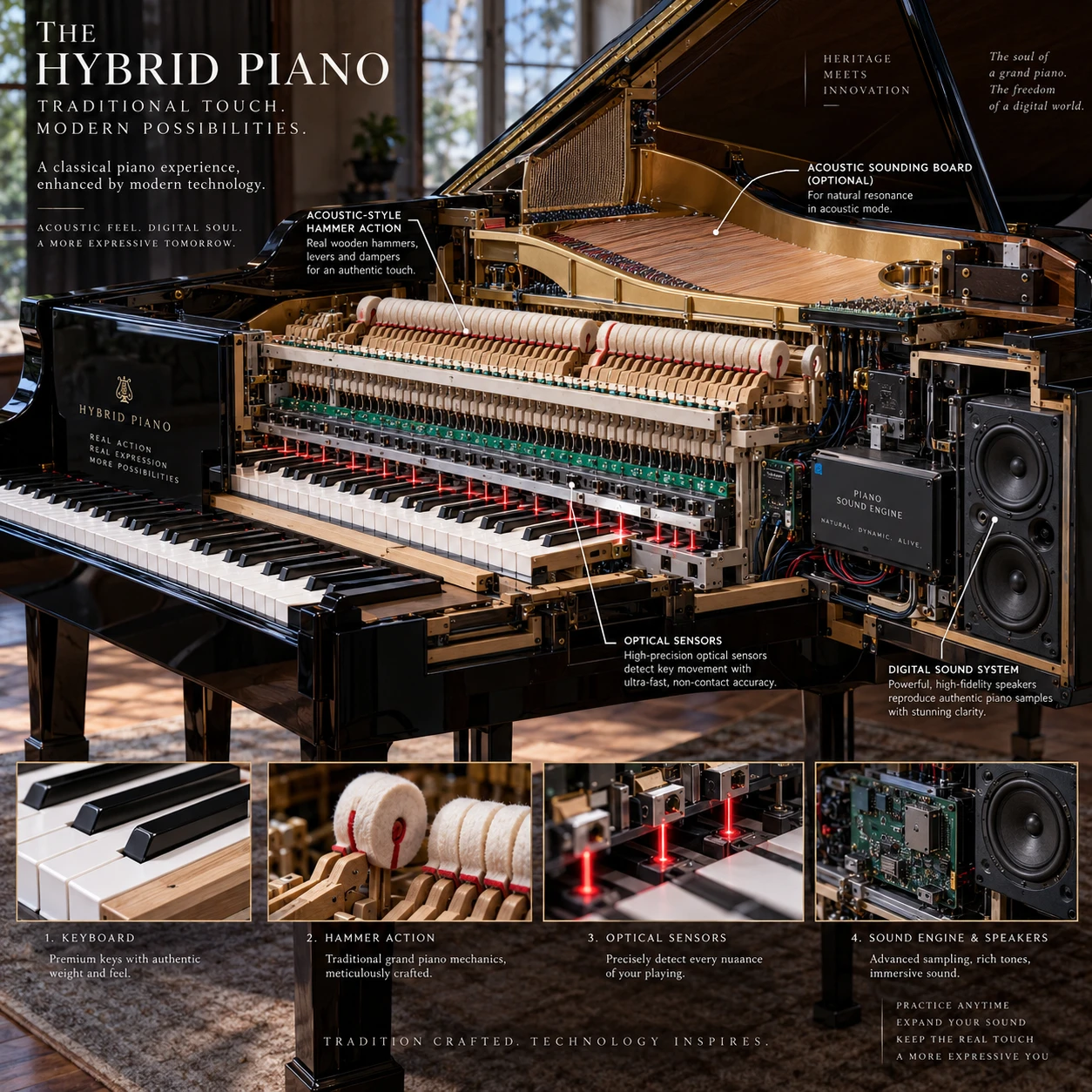
Press a key on a hybrid piano and you set a physical mechanism in motion, even though the instrument’s musical sound comes from electronics. That combination is the defining idea behind a hybrid piano: it pairs an acoustic-style key action with sensors and a digital sound engine.
Understanding the distinction helps explain why hybrid pianos can feel different from many conventional digital pianos. The keys and action provide a mechanical response; sensors measure the movement; and the sound engine turns that information into audio. The details vary by model, so no single diagram describes every hybrid piano.
What Makes a Piano “Hybrid”?
A hybrid piano combines a substantial, piano-style mechanical key action with electronic sound production. Its action can use real keys, hammers, and related parts, while sensors detect the player’s movements and trigger sound through speakers or headphones.
An acoustic piano uses the action to propel hammers into strings. In a hybrid, the action may reproduce much of that mechanical sequence, but it typically does not need to strike sounding strings. Instead, key movement becomes performance data for a sound engine, which produces sampled or digitally modeled piano audio.
“Hybrid” is a category, not a promise that every instrument uses identical parts. Some designs use an acoustic piano action with its strings and soundboard removed; others employ a purpose-built mechanism intended to preserve a similar key-and-hammer response. Sensor type, action geometry, and the way escapement is implemented can also differ.
The important distinction is between the physical action and the electronic voice. The action influences how a key moves and responds under the fingers. The sound engine determines the audible result, including timbre and other modeled or recorded sound characteristics.
The Key Action, From Key Press to Release
When you press a hybrid piano key, the key rotates around a pivot and moves the action; a hammer mechanism responds, sensors register the motion, and the action resets as you release the key. The sensors relay performance information to the sound engine, which generates the note.
Here is the basic sequence:
- Key movement: The front of the key moves downward around its pivot. The key’s balance and leverage affect how the movement feels.
- Action movement: The key engages connected parts that transfer motion toward the hammer mechanism. The mechanism’s shape and moving mass contribute to the resistance and response you feel.
- Hammer travel: A hammer moves toward the point where it would strike a string in an acoustic piano. In a hybrid, sensors detect the motion before any electronic note is produced.
- Note generation: The sensor signal is interpreted by the piano’s electronics. The sound engine uses the performance data to produce audio.
- Release and reset: As you lift your finger, the key and action return to their resting positions. That reset matters because it prepares the key for another press.
The process is connected, but the parts have separate jobs. A hammer’s movement does not itself create the electronic sound, and a sensor does not supply the sound. The mechanism creates the physical response; the sensor reports movement; and the sound engine creates the audible note.
Keys, Hammers, and Escapement
Keys, hammers, and escapement shape how a hybrid piano responds under the fingers. The key is the player’s interface, the hammer mechanism supplies moving mass and action feedback, and escapement describes a point in the action where the hammer’s motion is released from direct key control.
Keys and the key pivot
A piano key works as a lever: pressing its front end makes it rotate around a balance point, or key pivot. Key length, pivot placement, weight distribution, and friction can all affect the distance and effort involved in playing. Two keyboards with similar-looking keys may therefore feel different.
Hammers and the hammer mechanism
In an acoustic piano, the action accelerates a hammer toward a string. In a hybrid, a hammer mechanism may move in a similar way to provide a familiar mechanical response, though its path and construction depend on the design. It is the action’s motion and resistance that the player feels; the hammer does not automatically mean the instrument produces acoustic piano tone.
Escapement
Escapement is the action’s release point: near the end of a key press, the hammer is allowed to continue its travel rather than remain rigidly connected to the key. In an acoustic piano, this lets the hammer strike and rebound from the string. Hybrid designs may reproduce escapement or a related sensation, but implementation varies.
Escapement can matter most when playing quietly or controlling repeated notes, because it contributes to the action’s feel near the bottom of the key travel. It is only one factor, though. Key geometry, regulation, hammer mass, and the sensor system also shape response.
How Sensors Capture a Performance
Sensors detect key or hammer movement and send performance data to the piano’s sound engine. They do not make sound by themselves; the electronics interpret the data, determine how the note should respond, and produce audio through the instrument’s output system.
Depending on the design, sensors may track a key’s position at more than one point in its travel, or detect movement in another part of the action. Comparing successive readings lets the instrument estimate how quickly a key is moving. That velocity information is one way the sound engine can vary a note’s response according to the force and speed of the press.
The sensor system also has to recognize the timing of a press and release. This matters for articulation: a note should begin when the player strikes the key and stop or change when the key is released, according to the instrument’s settings and sound model. For repeated notes, the action must return far enough for the sensors and electronics to register another press.
Sensor design is one reason hybrid pianos are not mechanically or electronically interchangeable. The physical action can feel convincing while the sensor and sound engine determine how accurately the instrument translates a performance into sound. Conversely, a capable sound engine cannot change the underlying weight and movement of the keys.
Hybrid vs. Acoustic and Digital Piano Actions
The main difference is what happens after the key action moves: an acoustic piano uses hammers to strike strings, a conventional weighted digital piano usually detects key movement with a more compact keyboard mechanism, and a hybrid combines electronic sound with a more substantial piano-style action.
- Acoustic piano action: Keys, action parts, and hammers work together to strike strings. The strings and soundboard produce the instrument’s acoustic sound, and the mechanism requires physical maintenance and regulation over time.
- Weighted digital piano action: Keys use weights or other mechanisms to approximate the resistance of a piano keyboard. Sensors trigger electronic sound, often in a more compact instrument. Actions differ widely, and some are designed for nuanced control while others prioritize portability or cost.
- Hybrid piano action: A more substantial mechanical action, often with hammer components, works with sensors and electronic sound production. It can offer a different physical response from many weighted actions, while avoiding the need for strings to produce the note.
No category guarantees a particular feel or suits every player. A hybrid’s larger, more complex mechanism can take up more space and add mechanical complexity. A weighted digital action may be lighter and easier to place in a home, though its key movement can feel less like a full acoustic action to some players. An acoustic piano offers direct string sound, but needs a suitable environment and ongoing care.
What the Action Means for the Player
The action affects how a piano responds to touch, repetition, and release, which can influence a player’s comfort and control. The best way to judge it is to play passages you know at different volumes and tempos, rather than relying on labels such as “realistic” or “weighted.”
For quiet playing, pay attention to whether you can produce soft notes consistently. For repeated notes, notice how far the key must return before it responds again. Chords and fast passages can reveal whether the resistance feels manageable across the keyboard, while slow scales make unevenness easier to detect.
A useful listening-and-touch check separates three questions:
- Movement: Does the key’s weight and travel feel comfortable to your hands?
- Control: Can you shape loud and soft notes reliably, including at a low volume?
- Reset: Does the key recover quickly enough for your repeated-note technique?
These qualities come from the interaction of key pivot, hammer mechanism, escapement, sensors, and sound engine. Practice habits matter too: a familiar action can make it easier to focus on technique, but no mechanism replaces attentive practice. Players moving between instruments may need time to adjust, particularly when key resistance or repetition behavior changes.
Hybrid Piano Key Action: Frequently Asked Questions
Hybrid piano actions vary by model, but the same core distinction applies: mechanical parts shape key response, while sensors and electronics create the sound. These answers clarify what that means in practice.
Does a hybrid piano have real hammers?
Some hybrid pianos use real acoustic-style hammer parts, while others use a purpose-built hammer mechanism. The exact construction depends on the model, so “hybrid” alone does not specify the hammer design.
Does its key action make sound acoustically?
The action may produce quiet mechanical noises as parts move, but the piano note normally comes from the electronic sound engine, not from hammers striking sounding strings. The action and the note-generation system have separate roles.
How does a hybrid action differ from a weighted digital action?
A hybrid generally uses a more substantial piano-style action with hammer components, while a weighted digital piano often uses a more compact mechanism to provide key resistance. Both can use sensors and electronic sound, and designs within either group vary.
Can key-action design affect playing technique?
Yes. Key resistance, travel, escapement, and reset behavior can affect how a player controls dynamics and repeats notes. The effect depends on the player and the specific action, so trying familiar music on the instrument is more informative than judging the mechanism by its category alone.